
Guest:
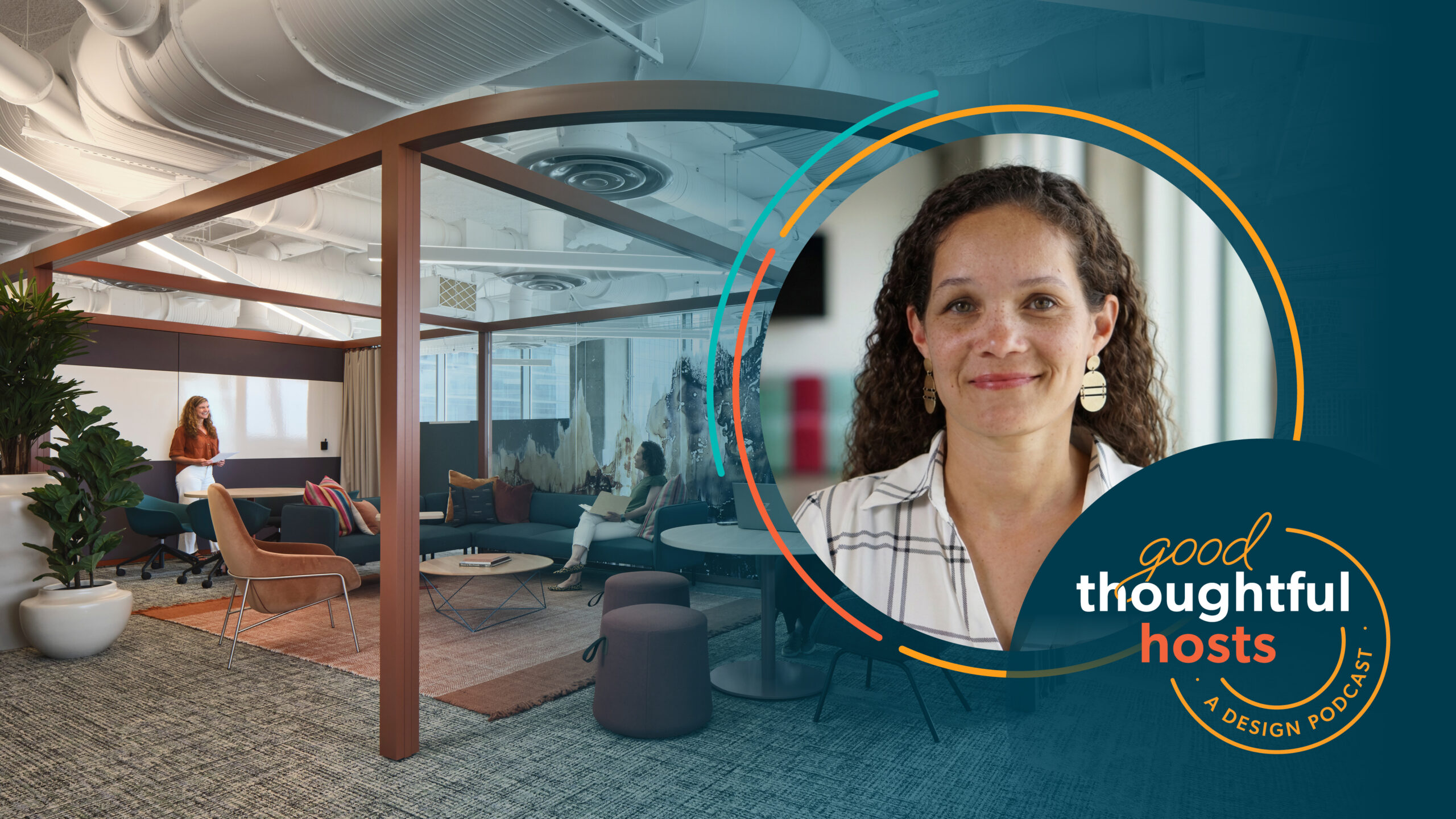
Sandi Rudy, Interior Design Director, Cushing Terrell
Overview:
In perfect alignment with this season’s theme, we’re chatting with Interior Design Director Sandi Rudy, who recently became a Certified Design Futurist. We’ll discuss how to identify signals that might inform design and create tangible, data-driven concepts. Sandi also talks how she’s used this framework to help tackle challenging questions, such as the future of offices.






Episodes transcribed by AI and proofed for accuracy and spelling by our team.
Sarah Steimer 00:08
Hi, folks. Welcome to Good, Thoughtful Hosts. I’m Sarah Steimer, and today we’re taking a different approach to our “at the forefront” theme. Whereas much of the conversation this season has been around the cutting edge or groundbreaking work currently being done, we’re going to switch gears and talk about how to think about the future. It’s kind of a funny time to be having this conversation right now, and I say that because we’re in the midst of celebrating America’s 250th birthday, which has most of the country looking back instead of forward. We’re thinking about the milestones, the people, the inventions, and the culture that has defined us to this point. But it is worth noting that many such shining examples of our history were advancements of some sort. I just ran across a story about a time capsule that was buried in Philadelphia this past Fourth of July, which will be reopened in 2276. Included were sports memorabilia, an iPhone, an American flag from the 2026 Rose Parade, and items that were submitted from all U.S. states and territories. One of the most interesting things submitted, I think, was actually something about the future. California included AI-generated predictions about what the state would look like when the time capsule is reopened in 250 years. I won’t spoil it, but I will include an article about the predictions that Claude came up with in the show notes. So this is all to say that we might as well be thinking about the future today. But it’s all just hearsay unless we put some real weight behind it, and that is what we’re going to be talking about in this episode. How do we take note of trends and signals that may point to a shift in the future, and then how do we use those data-driven insights to actually develop plausible scenarios? It’s exciting stuff. So let’s get into it.
Producer 02:26
Today’s special guest.
Sandi Rudy 02:29
My name is Sandi Rudy. I am director of interior design at Cushing Terrell, an associate principal and a certified design futurist.
Sarah Steimer 02:39
Awesome. Thank you so much for coming on the podcast today. We’re going to start with that last bit of your title, with your being a design futurist. To begin with, what the heck got you there? How did you wind up— I never heard of this before until you guys basically told me about it. But what is a design futurist certification? How did you wind up finding out about this?
Sandi Rudy 03:02
Yeah, this is a certification through IIDA, which is International Interior Design Association, and I happened to be at a trade show a year or so ago where there was a panel talking about the questions that we all have around design right now. What is the future of workspace? How is retail changing? All of these types of things, and it was a lot of the same questions that were being posed, and a lot of the same answers. But there was a person on the panel who had done this program, was one of the first people to do the Certified Design Futurist program, and her response was, “Let’s talk about a scenario where you know X, Y, and Z is the future, and what does that mean for design?” And it just, it opened my eyes to say, oh, there’s a different way to talk about design, and there’s a different way to talk about what it looks like in the future, rather than asking just the same questions and giving the same answers that we often hear. So that was the first that I had really heard about the program, and it was just like I was immediately drawn in by the way that she spoke about this future scenario, and so that was the first time that I’d really looked into it. It was, seemed like something, especially with the clients that we work with and the things that we deal with, seemed entirely relevant. And so, yeah, I signed up and did the program, and am now a certified design futurist.
Sarah Steimer 04:19
First of all, congratulations. But this is a really interesting thing. And when you and I spoke prior to this podcast recording, and when I kind of dug into it a little bit myself, this almost feels like a course that any of us could benefit from, regardless of what field that we’re in. And what I want to begin with, there’s this phrase that sounds like it’s used in this certification process called strategic foresight. Can you kind of break down what strategic foresight means?
Sandi Rudy 04:52
Yeah, absolutely. And this is something that absolutely spans beyond just interior design. That’s the framework of where I took this program, but it definitely broadens the spectrum to any aspect of really of our lives. Yeah, the the idea of strategic foresight; those are really key words. And the way that I’ve looked at that is that it’s a data-driven practice for developing plausible scenarios to inform long-term planning. And there’s really three key phrases within that. Data-driven: So we all have ideas, like I think that this might happen in the future, or I see this happening, which makes me think that’s going to happen. And it’s really putting data to that. So these are, it starts as a big idea, but it’s going back and doing the research and finding the data that supports that. It develops a plausible scenario, so that’s a key component of it. To say we have this idea and we’ve really looked at the research and the data, but here’s a scenario where this is plausible, and that’s I think one of the key things that maybe being on the forefront of ideas, being a thought leader, differentiates in being a design futurist, because it’s putting a plausible scenario to an idea and to the data. And then the third part of that is really the long-term planning. That’s what we’re giving to our clients, and that’s really the benefit to the client is that they can come away and say, “I have a plan of how this big idea affects what I am putting into place today, and this design firm has given me a plan and tangible things that help me reach that future scenario. So it’s really all three of those things coming together to make it this idea of strategic foresight.
Sarah Steimer 06:35
It also sounds like this goes so much far beyond just trying to predict something. You know, you’re not trying to play the prediction markets or anything like that. You’re, you are saying like, you’re taking this data-driven approach, but you’re also adding so much weight behind just saying trust me, this is going to happen. Now let’s kind of walk through the process because that phrase you just gave us, that sentence you just gave us, and you broke it down into those three parts. That speaks toward this full process itself. So, if you would take us kind of step by step through this process.
Sandi Rudy 07:09
Yeah, that first process is really finding the data. So, whether it’s a client that brings us a question, or if it’s us seeing friends or signals that we want to then further explore. It’s taking that next step to say, let’s find the data behind that, and so it’s really looking at that broad spectrum. And this is to your point earlier that this isn’t just about design. This could be in any realm. We really want to look at every realm that affects that eventual design solution. So finding data that’s related to the current political climate. Finding data that’s related to socioeconomical statuses. Finding data that’s related to technology. All of those things can impact what is eventually a design solution. So, data, first part of that. The second part is really then deciphering that to say, okay, that data is telling us things, and we need to analyze: Are those trends that have some weight that we need to continue looking at and dive further into? Are they things that we can say, okay, let’s put this one on the back burner? Because in in the in the realm of research, you could get lost in research and never get out of research, and that’s really part of the program is to say, let’s organize the research, let’s find some specific examples and let’s move that into design solutions. From those design solutions, we really want to start to build, again, that scenario for the client. So that would be saying, let’s look at the who, what, when, and why of this scenario, and those are the things that are tangible for a client that we want to, as an example, we might say, “What is the future of work?” That’s a question that we’ve all heard. We’ve heard many times, and we’ve heard it described in many ways. That’s a really big, broad question. So we really want to digest that down a little bit for the client to say, “Okay, what is the future for this segment of the workforce? What is the future for this segment of the workforce in X amount of years?” We want to start with that big idea and really digest it down to something that is again more tangible for the client and can start to build a future that they can visualize for their workforce. And so that, that’s, those are the big steps of like starting with a question and breaking down that data into tangible aspects of it, and then really this program teaches then a way to say, okay, from that future that we’ve thought of, what are the parts and pieces that we can then break out and say, what does it cost to implement this solution today for the client for that future that we’ve imagined in 10 years or in 20 years? So there’s many steps to the process, but it really helps. I feel like it it fills in a need that’s been there to get from a big picture to a tangible idea that is implementable to clients today.
Sarah Steimer 09:55
I think the piece of that that I find most interesting, and I want to get your take on this, but that idea of learning to recognize the signals. That kind of sounds like the almost the superpower here in this whole process, in a way, and something that we don’t naturally have. It’s almost like a version of being a trend spotter, but the trend hasn’t started yet. It’s not even cresting necessarily. So, can you tell me a little bit about what it’s been like to develop that ability to catch those signals, be open, to have your radar out, to be able to grab those signals?
Sandi Rudy 10:35
Yeah, very much so, and I think that’s one of the great benefits of this program, and it’s something that I have noticed that’s a difference in how I’m operating day to day as an interior designer. I always am looking for things that inspire me. So if it’s going to a restaurant and seeing how they’ve used a specific material or a light fixture that they’ve used, or going to a workplace and seeing how they’ve arranged things, I’m always looking for those things. But this course has taught me to broaden that lens, so I’m not just looking at that kind of micro level that that is most related to my profession. I’m looking at things now in a very, a very broad sense. So acknowledging and seeing when there’s those signals and taking the time to investigate them more are two things that I find that I am doing. Just as an example, I have a 13-year-old son, and he is, he really wants an e-bike. All of his friends are out riding e-bikes. You see on the news that this group of teenagers has taken over a street on their e-bikes, and you could look at that and say, “Oh, that’s just kids. You know, it’s what they’re doing today.” But if you look at it from this lens, okay, what is that telling us? Is that a signal that we need to start watching? That we have already seen that there are signals and trends that less people are driving. We’ve seen this now. Is this a signal that we need to pay attention to about e-bikes? If we took again, that who, what, when framework, let’s say, okay, these kids who are 13 right now are obsessed with e-bikes. What does that look like when they’re 23, are they now driving a culture that is focused around bike transportation, e-bike transportation, as opposed to cars? What does that mean for spaces that are then designed? Are we designing more not just walkable but bikeable, but maybe in a radius that is e-bikeable? Are those kids in 10 years the ones who are saying, “I don’t own a car. I own an e-bike, and everywhere that I go is within this 10-mile radius that I can get to on my e-bike.” And so, does that start influencing the way that design is focused in terms of everything that that they need? Their workspace, their food spaces, their entertainment are all in that same zone. So that’s just one example of like how you could ignore something to say, oh, this is just what’s going on right now, or you can look at it and say, what are the things that we need to analyze in this scenario? That again, an e-bike is not related to interior design at all until you start looking at it as a signal. So that’s, I feel like has been the biggest component for me is just awareness of not ignoring things that are happening in life, because they could be a signal that then influences a client’s future, and we need to be able to acknowledge that and look at that in in terms of design.
Sarah Steimer 12:53
This, I love that example too, because that’s that could be so easy to ignore. You know, a lot of 13-year-olds, teenagers loving a thing, that that could just be something like, oh, it’s a trend, like brush it off. But it could also be a sea change, and so that’s such a unique perspective to be able to have now. So let’s take it into your work a little bit because you mentioned how you came to the certification was in grappling with this idea of the future of work, so can you talk a little bit about how you’re now using this approach to think about where we may see workplaces move in the future?
Sandi Rudy 13:52
Yeah. So as part of this certification course, that was the the burning question on my mind because it’s been out there forever, is, what is the future of work? So that was the question that I used for all of my research and homework for the certification, and it was really interesting because you start looking at the trends and how they impact things, and it’s some of these things that we may have talked about before, but trends that again may not seem like they are aligned with workplace, but still things that are absolutely valid to look at in building this future scenario. So I happen to look at the question of what is the value of the workplace for Gen Z in the next 10 years, and so some of the things that I came across in terms of my research were just things in the education realm. More women are enrolled in higher education than men. College enrollment rates are dropping. This generation are digital natives. They— and again, you start to see where things start to align in the research too — so these digital natives are turning toward technology for education, which may be why they’re not attending higher education in the same rates because they feel like they have that information at their fingertips. This generation really values physical and mental health. They’re absolutely aware of those impacts on their well-being, and that’s taking as much priority as career and workplace. So again, starting with the data and the trends, those are just some of the trends that have the substance to to continue to follow. And for my efforts in this, I continued to look at those and how they start to impact workplace, and looked at a scenario again, building that future scenario where the workplace enhances the idea of wellness, enhances mental health and well-being, and then also maybe the workplace provides more on-the-job technical training that people are not getting in those secondary education spaces. So again, that’s an example of here are trends that we’re seeing, trends that do hold weight and how those might then affect how people are using the workspace. So in my homework, I did a future scenario where you know in in the year 2036 there are people who work in a smart building tower that adjusts to their exact needs based on their their technology and their wearable devices, knows who’s coming and who’s going, can adjust as needed to meet their their biological data from that day. So the building is fully in tune to how they are operating in that day and that particular time, that it’s a building that, again, is the root of health for them. So the building, they are trusting that building is filtering air. That the air quality that they get within the building is maybe better than what they’re getting outside of the building. That that building itself, using AI and smart technology, is sensing what’s going on outside and adjusting how it’s performing inside to balance that out as well. That in this scenario that I built for this hypothetical client, this was a 24-hour operating building, and so utilizing AI and robotics to maintain systems to run 24 hours a day. I think another trend that, another signal and trend that was coming up in a lot of the research is that this particular generation, Gen Z, is more globally connected than any other generation before, and so the possibility that they would only work with people who are in their same time zone reduces drastically. That there might be people who only work with people on the other side of the world, and that’s their community. So the building needs to operate 24 hours a day to accommodate those types of work schedules. So in this scenario that I had built for this hypothetical client, it was just a future scenario where those things were coming together to where the building was the core of this health and wellness aspect, again, reacting to the users who are coming and going, and providing for them to be able to live a lifestyle that met all of their needs, and then again that last part of that of making it something that the client could connect to, pulling out items from there that this client could possibly implement into design today to allow for that 10-year-in-the-future scenario.
Sandi Rudy 18:05
Who among us wouldn’t mind an office that’s responsive to what our needs are that day, so that it’s a little bit easier to work? Of course, that just makes total sense, and especially from a generation that has become so used to customization and personalization, and so forth. That’s really fascinating. I want to talk a little bit more about the client side of this now, because I’m sure talking among your colleagues or other folks in the industry, it’s easy to get excited about this sort of thing and want to explore the future with the knowledge that you have. But I do imagine that is probably a slightly harder sell for clients because you’re telling them about something that could happen, and companies maybe don’t always want to bank on the unknown. So, how do you talk to a client along those lines?
Sandi Rudy 19:10
Yeah, I think that the way that this program is set up, again, going all the way back to data-driven, plausible scenarios, and planning, those three things make that conversation with the client a lot easier because it’s not just, here’s a big idea, let’s do these things and maybe it’ll work out. So, just the framework of it being rooted in data allows the client to have things that they can point back to and say, okay, these are the reasons why that plausible scenario. So again, that hypothetical future scenario that I came up with, it included a couple of things. That, those are the things that we would then go back to the client and say, okay, we talked about this 24-hour operation, and we’re going to use AI and robotics to maintain your HVAC, your lighting system, and do like routine maintenance so that there’s never downtime in the building. This program also provides a framework to then analyze the cost, the monetary cost, the cost to produce all of those types of things, and the benefit. So the user benefit, the environmental benefit. It gives you a framework to weigh those things and score any sort of idea that you might come up with in that future scenario. So, for example, that example that I gave of robotics and AI to maintain your mechanical system so that there’s no downtime in the building, we could say that technology generally exists today. So that’s plausible. The cost might not be exorbitant because we know that there are the things that can do it already. It’s not creating new technology. The benefit to the users, there’s no downtime. That’s a great benefit. It allows for regular monitoring, so people can know exactly the health of the building. That’s a great benefit of transparency in terms of the goals that we set. So let’s rate that one as a high and a plausible thing to do. So we could rate other things that were maybe in that future scenario. For example, we want a building that is responding to your wearable device for every single person. Okay, there probably is some technology, but to respond to every single person, maybe that has a higher dollar cost. We’ll rank that as a higher dollar cost. But is there a higher impact on the users of the space? Yeah, there’s a pretty good user impact there as well. So it does give a framework to then say, from this scenario, here are x number of things that we’ve identified. Here is the actual cost, and here’s the human cost. And let’s say which is and which is not doable in this scenario. So it really does give a framework to to really take it from, again, that big picture idea all the way down to maybe we’re only implementing one thing out of that future scenario, but it gives you a tangible and a data-driven idea that you could implement in a project.
Sarah Steimer 22:01
Yeah, I love that idea of almost the cost triaging in a way, and offering that to someone so you can go like, all right, it’s almost an appetizer platter. You can go with a little bit of this, a little bit of that. What’s going to be most important to you? What can you afford, of course. So that really, like you’re saying, it’s taking it a step beyond just, here’s the idea, here’s here are the signals we saw, here’s the data, et cetera. But how do you put this into practice, and then breaking it down from there. That, that really takes it a much further step than I would have anticipated when we were first talking about the program. So now that you have this certification, you’ve brought it back to your folks, your office, your team. How are you thinking about the way that this can be implemented company wide?
Sandi Rudy 22:46
Yeah, I think we’re always eager to get involved in projects earlier. We always say that the earlier you can bring us on, the better. I think that this really sets us up to really be thinking about projects before they even start. Again, if people are out there looking for signals, this is something that when a client then comes to us and says, “Hey, I’m I want to create this space,” we have the ability to say, “Oh, we have already seen all of these signals and this, these possible futures that might apply to you.” So it allow, it definitely will allow us to be involved early on in the process, which is great for existing projects, we’re looking back at them and saying, even if we’re halfway through design, taking a look back at them and saying, are these future ready? I think that we oftentimes, we’re pushed to complete projects as quickly as possible, but we, if we take that moment to say, okay, we’re doing these things with what we know now about this possible future by doing a little bit of legwork in the background, can we identify that, yes, this project is something that in the next 10 years it’s still going to be working well for our client for those futures that they might not have thought of or that we might not have thought of beforehand. So it definitely is something that we are able to implement in projects that are just starting, projects that have not even started yet, and projects that are underway. And I think the the great part about this too — again, circling back to this is not just an interior design thing — we’ve been looking at what this means: What is the future? We have folks doing a design competition on public toilets. That’s, okay, that’s a great subject to then look at the data around all of the things that impact public toilets. So just the, I think the depth that it gives to any project or any design challenge as well is just really exciting to not just say, let’s make something cool, but like let’s make something that’s really informed and something that is future-looking. So I think that there’s just great possibility for really great deep, deep, meaningful design, based on this information.
Sarah Steimer 24:45
First of all, if you need any additional help on the public toilet thing, I have so many opinions and thoughts about that. I’m not even kidding. This is something, anytime it’s brought up, I’m like, yeah, let’s get into it. So I know I’m particularly obsessed, I’m just going to say, with this idea of being able to recognize symbols— or signals, excuse me. Can you kind of walk me through as you’ve talked to your colleagues how you’ve maybe coached them to learn to find those signals, recognize those signals? I this is selfish. I want to learn how to do it too.
Sandi Rudy 25:19
Yeah, I think in talking with others, it’s really again just being aware. If there’s a conversation that I’m having with a coworker in the break room of something that they’d experienced over the weekend, okay, that’s a signal. You need to, we need to look deeper into this. I think it’s just opening the framework to not dismiss anything that that is happening as just just an occurrence. I think another example, I talked a little bit about college attendance rates at a dinner with soccer parents that came up as a topic that they have kids who are entering college and they’re doing these incubator sessions with professionals who are saying, if you have an idea, we’ll pay you to go chase that idea. We don’t care about your school. It’s like, that’s reinforcement of that trend that I saw. So again, looking, looking at the things that you’re doing. If you’re scrolling through Instagram, there are so many times that things come up. That’s, oh wait, is this a signal that I need to look more into? And usually, when you start looking at it, it’s okay, yeah, I’ve seen that now in three places, this is the signal that makes sense. Can I look at it in a way that then takes it to a design solution? So it’s really it’s really just awareness, awareness and acknowledgement, and knowing that there is potential in anything that you see that is happening. I feel like that’s the big thing, and for me, like literally and figuratively, an eye-opening experience to be like, oh, I should be looking for these things and seeing these things and analyzing how they can impact my everyday design. So I think that’s the biggest thing is just speaking and seeing and then doing something with them.
Sarah Steimer 26:55
It it almost sounds like it’s up leveling active listening to active observing in a way, and I’m curious to know how this has, now that you have this certification, you’ve gone through the process, you’ve integrated it in I’m probably sure many ways — how has this affected your creativity or maybe inspiration? How have you noticed that change at all?
Sandi Rudy 27:18
Yeah, I think inspiration definitely has, has broadened. But also has driven me to want to put more reasoning into design. And I think, especially the last few years in terms of design, we have seen such a huge change in every market that we work in. You could look at education; kids did school from home for a long time, and then are back in school. And technology is changing education, too. It’s driven me to not just say like, things are changing, we’ll figure it out, but but to go deeper and say, okay, why are things changing? What are again, what are the signals and trends that are causing that change, and how do we need to change design to be on the forefront of education spaces? Work spaces is the same to where we’ve seen the most change in the last five years. Obviously, driven by a global pandemic that shook everything up, but it’s forced a change that we now have the opportunity to say, “What are the next 10 years? How can we change things to make them better for the next 10 years? And this framework really allows me to think of things in that way, as opposed to just reactionary. Again, like I said, in terms of being on a project earlier, thinking about a project before it even is a project, it allows us to really come to the table of design with reason that’s not just react reacting to things. We, we, we are the ones who are now driving things that others are reacting to, which is a, I think a really exciting way to approach design and bring something special to the table for clients who are asking, What do I need? How do I design something for the future that I’m not sure what it is? We have the tools to be able to at least create a scenario that allows them something to design for.
Sarah Steimer 29:09
Sandi, I have one final question for you. Now that I’ve been able to pick your brain about this and hopefully implement some of these thoughts myself, because I do think this is a fascinating muscle to be able to build and use, but my last question for you is: Will your son be getting the e-bike?
Sandi Rudy 29:29
He is working hard to earn some money to get one. I’m maybe a holdout on it. I don’t know where he thinks he’ll go, but he’s working hard to get one. So we will see.
Sarah Steimer 29:40
Yeah, I get such a kick out of them. A friend of mine has one, and she’s got her two kids on the back, and she just zooms them over to daycare right past the line and everything. And yeah, she she loves it. We call her the, it’s the mom tank that that we call that e bike. But—
Sandi Rudy 29:54
Nice.
Sarah Steimer 29:54
Best of luck to your son for making enough to be able to get one for himself if you allow it. Sandi, thank you so much for joining today. I appreciate it.
Sandi Rudy 30:03
Yeah, thank you so much for having me.
Producer 30:12
Music for Good, Thoughtful Hosts was written, produced, and performed by Sam Clapp. Our moderator is Sarah Steimer, editing by Travis Estvold, and a special thank you to our content development team, Marni Moore and Trisha Miller. For more information about the podcast, visit thoughtfulhosts.com. Thanks for listening.