
Guest:
Sheri Blattel, Retail Design Director and DEI+B Leader, Cushing Terrell
Overview:
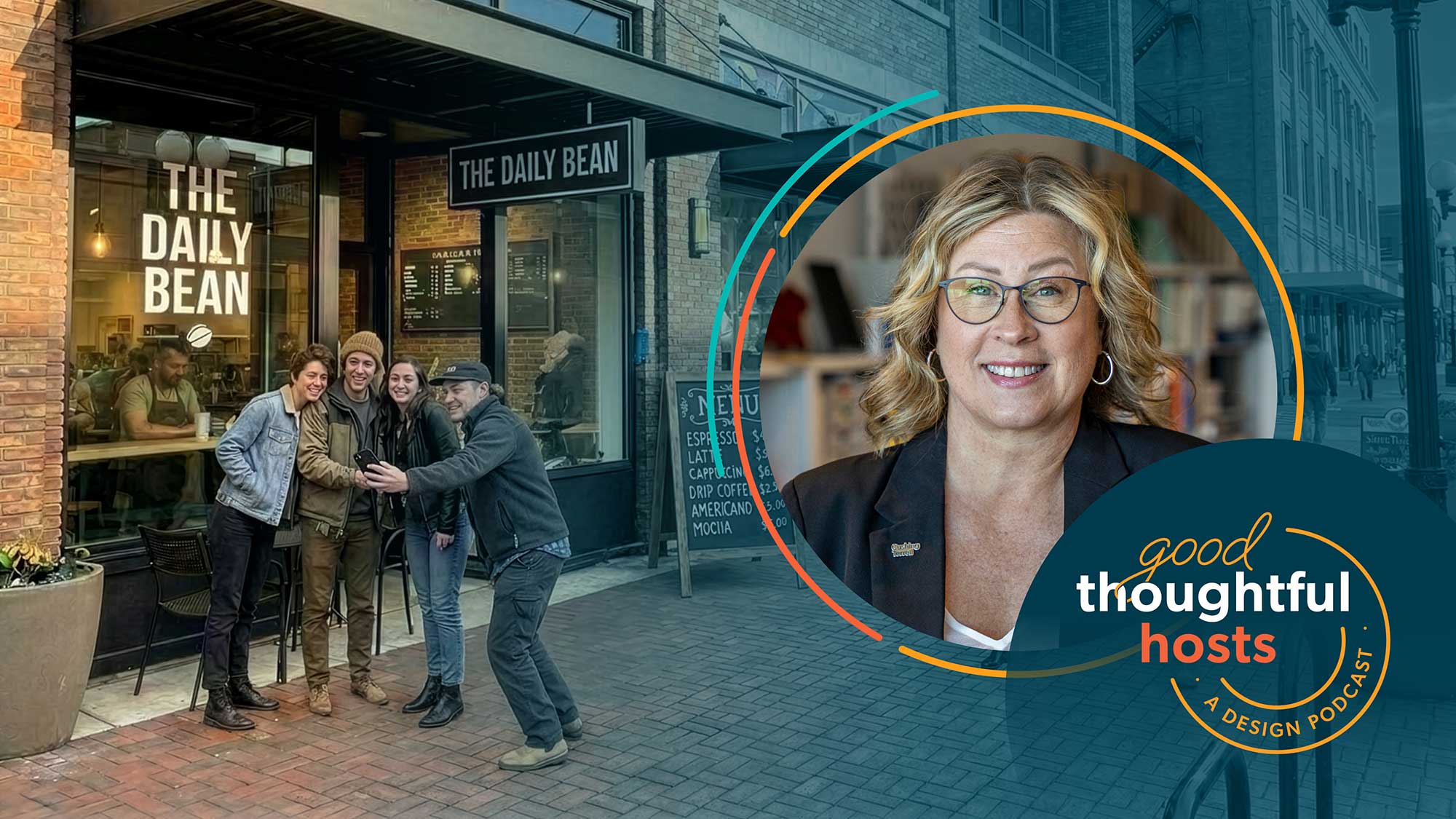
Retail Design Director Sheri Blattel joins the podcast this week to discuss the effects of artificial intelligence (AI) on physical storefronts and how retail businesses are answering the use of AI and quick fixes in retail with community-based, locally engaged retail environments. Sheri talks about the trajectory of AI in product sales and how retailers can prepare for longevity and dig into personality and connectivity in their built environments.

McKinsey & Company | Merchants unleashed: How agentic AI transforms retail merchandising

The Wall Street Journal | A New Generation of Mall Rats Has Arrived


Episodes transcribed by AI and proofed for accuracy and spelling by our team.
Sarah Steimer 00:08
Hello, and welcome to this episode of Good, Thoughtful Hosts. I’m Sarah Steimer, and today we’re diving into how we’re seeing technological advances, in particular AI, enter the physical retail space. AI might be an obvious component of online shopping, but we’re also seeing it touch brick and mortar stores. Our conversation is going to focus on three areas in particular: efficiency, store design, and customer experience. But before we get into all of that, you may well be considering why we’re talking about physical retail at all, especially in the same conversation as technological development, and despite years of reports that claimed physical retail was dying. Well, it turns out that heading to the mall is back, baby, and the trend is driven by some of the youngest shoppers. In March, the Wall Street Journal reported that Gen Z spends a greater proportion of their discretionary dollars in physical stores than older generations. And this stat really surprised me: Shoppers between the ages of 18 and 24 made 62% of their general merchandise purchases in store last year. But these digital natives are not shopping the way that their fore-mall rats shopped. Instead, it’s a very omnichannel experience for them, as they typically find outfit inspiration online, and maybe they’ll document their in-store experience for their own followers. Some digital-only retailers have actually begun to open physical stores in response to the desire for real-life experiences. So, let’s get into our conversation about the role of AI in retail, and how new technology and shifting shopping habits are influencing the way that stores cater to customers.
Producer 02:17
Today’s special guest.
Sheri Blattel 02:21
My name is Sheri Blattel, I am director of retail here at Cushing Terrell, and super excited to talk about our topic today.
Sarah Steimer 02:29
Sheri, thank you again for returning to the podcast. I’m also very excited about our conversation today as well. This popped up for a number of reasons, not the least of which was because I keep reading more and more about how younger generations are shopping, but we’ll get into customers in a little bit. First, before we do any of that, I wanted to just get an idea from you, generally speaking, how much is AI being discussed in relation to retail, particularly when it comes to physical retail spaces, which was an area I certainly would not have expected to think about AI in.
Sheri Blattel 03:08
So, most every conversation that I have been observing, and by the way, I just want to really point out here, I am no expert on AI. It’s new technology, it’s a new conversation. There’s lots of folks, lots, lots of folks that know more than I do, but I am a careful observer, and we are bumping up into it with our retailers, even with our clients, from the perspective of how we work on projects in our own workflow here in the office. So just wanted to state that first, no expert on this. But back to the question: Most every conversation that we’re seeing related to commerce has shifted to AI. The agentic commerce has elevated the relationship between the retail brands and their consumers. We’re dealing with high volumes of data in the retail sector, so that’s driving the need for much more intelligence in the automation that’s being used. Artificial intelligence is being deployed to achieve complex goals. It’s being used for multi-step workflows through autonomous action. That rapid adoption is occurring not just in retail, but we’re seeing it across lots of other industries: travel, fashion, grocery, legal services, healthcare, logistics, and supply chain manufacturing and even education, so it’s really being deployed very broadly, but the rapid adoption is occurring with these high volumes of data and complex digital workflows, but the earliest adopters, they’ve already occurred across platforms like smart home platforms and autonomous replenishment models, so those have been operating for a bit of time now, and those are the early adopters. But it’s a big conversation, and everyone’s trying to figure out how to best integrate it into their business.
Sarah Steimer 04:53
Yeah, I mean, it seems like the big question, almost regardless of what industry you’re in, is, is how are you planning to use AI? So I kind of want to break this down, like you said, this is an enormous conversation, and we’re going to take this just little bitty chunks here, and obviously it’ll just be a drop in the AI ocean, but I wanted us to kind of break this down by talking about three things in particular: efficiency, store design, and customer experience, or branding. So, let’s start with efficiency, and you kind of, you began to touch on this a little bit in your introduction. Can you tell me a little bit about where we’re seeing AI used in terms of retail efficiency?
Sheri Blattel 05:40
Well, first I want to just kind of throw out a little bit of a statistic here. So, between 70 and 80% of retailers are currently leveraging agenic AI, and what they’re seeing is a 20 to 35% in cost reduction, and then a 30 to 40% in efficiency improvement. So, it really is a tool for efficiency, which is the lens through which I think a lot of retailers are looking at this now across all of their operations, but as it relates to tasks, it really shifts that and eliminates that mundane task and mundane effort, and then it shifts the store associate to a higher value, customer-facing effort, and then what that does is it amplifies that store associate into a brand ambassador, because those time-consuming and kind of rote tasks are now being handled by an agentic agent.
Sarah Steimer 06:32
An area that I was actually surprised that you brought to my attention was something that I would not have necessarily expected to see it in terms of efficiency, but it does make a lot of sense, and I was hoping you could break this down for us a little bit. It’s being used for loss prevention, and I think this was a statistic that you actually gave me, which was that something like 60% of retailers have implemented AI for loss prevention. So, how is it, how is it possibly being used in that regard?
Sheri Blattel 07:01
I can’t, again, can’t tell you how all the platforms work, but you know, retail theft, not just, you know, across grocery and fashion, and you know, I think Walmart is one of those that adopted some of this loss-prevention AI very early, but it is a $100 billion-a-year challenge for retailers. And so what has happened is AI has allowed the adopters to shift to being more proactive as opposed to reactive. Certainly still hurdles in implementing that, because the, you have to get the balance between identifying and catching that theft activity, but also maintaining a frictionless and seamless and non-invasive customer experience. And so again, don’t know how all the platforms work, but it’s able to assimilate large volumes of data, and I think that is the secret to AI, is this large volume of intelligent data that AI agents are then able to lean into and make these intelligent decisions, and so what they’re doing is they’re scanning inventory, they’re scanning activity. Obviously, there’s a lot of audio-visual equipment, and related to this platform, or whatever is being used, and I can’t name them all. There’s quite a few out there, but you know, cameras are being used, motion detectors are being used, but you are correct, loss prevention and theft is huge for retail, and AI is providing an opportunity for them to get out in front of that activity, as opposed to trying to be reactive and unable to get that managed.
Sarah Steimer 08:35
And then you mentioned, as well, talking about being able to free up some of the staff to focus more on things like customer service, things like that. Talk to me about how AI kind of steps in there. I know there’s these ideas of dynamic pricing and staffing, so being able to maybe change things in a more probably time-sensitive reaction versus, oh, we saw over the last two weeks the manager made the schedule that maybe we need to shift it for the next two weeks. Is it more of this immediate response to what might be needed on a day-to-day, case-by-case basis?
Sheri Blattel 09:10
Yeah, so those dynamic models, they’re they’re enabling real-time market adaptation across all the retail channels. They’re seeing where all the activity is, they’re able to balance demand, they can evaluate event-driven shopping, say, like the Super Bowl. They can monitor weather impacts, either to the store itself or to the supply chain, and they monitor volatility in product availability. And then, obviously, whenever there’s a shift in the market, they can be really responsive to pricing with greater accuracy by using those models.
Sarah Steimer 09:45
All right, so this was all, I would say as far as the efficiency topic goes, when it comes to AI and retail, maybe these are some of the things that we could have anticipated. I feel like efficiency is a big piece of the conversation when it comes to AI across the board, across industries, etc. So, let’s move into store design, because this is really where I was much more surprised to hear about AI being used.
Sheri Blattel 10:09
Yeah, we’re gonna have fun with this topic. So, I’m gonna back up and set the stage real quick, because I think what is important to talk about when we’re talking about store design is to back up and talk about what is happening with the store associates, and that that branches off that efficiency conversation. And so the store associates are becoming key in this AI adoption and transformation. You know, AI is working in the background or in whatever tools they have, and so the store associates, like I mentioned, they have this opportunity to be elevated to brand ambassadors, and then what happens is that in-store experience becomes more significant than ever, because the associates are delivering more personalized experiences in the physical space. You know, you can see them now, even in the stores, they’re not sitting behind a counter anymore, they’re equipped with handheld devices and tablets to have personalization right at their fingertips, they’re out engaging with the customer in the store, like I said, as opposed to being behind the counter and just kind of hanging out back there, and so the brand ambassador or store associate, now they have become much more operationally intelligent, and so that shifts them more toward a service model and an experience-oriented model than it, rather, being just simply transactional. So I think it’s important to set that stage before that, we then move into talking about store design.
Sarah Steimer 11:28
No, that’s that’s incredibly— I just want to pause real quick, because what a good thread to tie through there, because it’s still, you know, to kind of see, and I’ve, I’ve experienced this in stores, and I’d love to hear, you know, if you have an experience with this as well, where it does feel like there is this connection more between the digital world and the physical world, and it often comes by way of the person walking up to you, like you’re saying, with an iPad, or to be able to show you, oh, we don’t have it in stock, but look, I can order it for you. This just happened to me at a Vans store recently.
Sheri Blattel 12:01
Yeah, no, that’s exactly how it works. And so I think that, in my opinion, it is sort of reshaping that retail brand experience and the customer interaction. Discovery, the aspect of discovery across a seamless omni-channel journey is replacing the idea of convenience, so discovery has really become paramount, and that’s being leveraged by huge amounts of data, and the predictability for AI to understand what that consumer preference is, but what I mean by that shift is that we’re going from static product placement to dynamic adaptability of products, but then also in a parallel conversation, we’re talking to retailers. I’m hearing at conferences, everyone’s talking about really becoming agile and having store layouts that are adaptable, and so those two things tie together. I think they’re very important for one another. And then we have this AI in the background that’s tracking the regional influences and the customer traffic and the patterns in the physical space and dwell time, and then, of course, inventory movement and product features. And so that physical space has become extremely important, along with that brand ambassador in that space. And so, you know, in my opinion, the retail physical space now is more important than it ever has been, but as it relates to design, I think that what you’re going to see is that you have this enabled brand ambassador, you have this ability to adapt product placement, and it really is more about that experience of connection, which you mentioned earlier. I will give you an example, though. The other thing that we see happening that I think it’s also greatly tied to this, and it’s an impact of this discovery between online and in the physical space, is that IKEA, IKEA has massive 300,000-square-foot showrooms that you know you wind through, and there’s so many things happening that they have shifted their model, and they’re opening what they’re calling IKEA studios. And they’re smaller footprint, you know, like even 5,000 to 1,000 square feet, and it’s more about creating that studio environment, knowing that all that inventory that would have existed in a 300,000-square-foot space is now at your fingertips online, but you’re still in a physical space having the IKEA experience in a studio setting with a brand ambassador. And so I think that that’s just a quick and easy example to kind of illustrate the impact that’s being had on physical space. Does that make sense?
Sarah Steimer 14:30
That makes so much sense, and I love that example, because if there’s one thing I feel like IKEA does better than anyone else is do that showroom experience, and then, of course, then you go and find your items, or whatever it may be. But to see them really focusing in on that, like you’re saying, knowing that you can then just beep bop boop, it’s at your door, instead of necessarily having to borrow a friend’s truck to get your patio set home, that’s a really interesting example. And, and I will be really curious to see if more stores shift more to this showroom style versus almost warehouse that they have long been.
Sheri Blattel 15:11
I think on the flip side of that, though, what we’re also seeing is that, particularly we’re seeing this in grocery, is that there is space being carved out so that you have your physical space that your customer is experiencing, but also there’s a part of that square footage that’s dedicated to sort of that last-mile delivery, and so it is a fulfillment center as well. So there’s back-of-house space or side-of-house space that’s being used for that particular function, and so it’s also sort of reshaping how folks are looking at how they’re using their allocated square footage, but in a space also where things are much more expensive, rents are more expensive, construction costs are more expensive. Smaller footprints, that is a trend across retail, across fashion and grocery and specialty stores and luxury stores. You are seeing smaller footprints that are being driven by all those things I just mentioned.
Sarah Steimer 16:15
This takes us perfectly into our next main topic, which is that customer experience or really this brand, because of course, as we move forward, as people do continue to really shop online and shop in a different way online, and I do want us to get into that agentic AI shopping experience, but you can type in to your Google search that you’re looking for a long-sleeve red t-shirt, and it will present you with a zillion, across many brands. But you’re kind of losing that typical brand experience that you would receive if you actually went to, let’s say, Eileen fisher.com or if you walked into an Abercrombie and Fitch. So I really want to get a sense of what we’re able to do with AI as it relates to customer experience and branding.
Sheri Blattel 17:15
That’s a great question. So, first of all, that omni-channel integration has become extremely important, but the expectation is there’s no differentiator between that online experience and the in-store experience. So, the online piece that you just described, that is the discovery aspect, that is doing your research, understanding what it is you’re looking for, who has it, and then can ask it to drill in deeper, because that’s what I’d ask you to do, right? And then you can get more specific with a specific brand, and then that shopping experience moves to a physical space, so they can connect with the product. They may or may not buy that in the physical space, they may come back home and buy it from that same interaction they had online, but it’s all part of the discovery process, and you know, I believe wholeheartedly in retail therapy. I believe the physical space is very important. You know, the dopamine of the hunt is often stronger than the pleasure of the find, and so that discovery aspect, I think, is being amplified by the fact that AI is working in the background, it’s giving you all these options: you can explore, you can look around. You know, I’m gonna put my Gen Z shopper hat on. You know, they’re looking at peer reviews, they’re looking at influencer content. I think it’s retailers or brands, or anybody that spends a lot of time writing their own reviews for their own products, they’re not paying attention to that. They’re looking at peer reviews and what the other folks that are around them are, how they’re using the product, what products they’re using, what they say about those products. So it, I don’t want to keep repeating it, but I do think that this discovery component is super important.
Sarah Steimer 18:53
That idea of retail therapy, of actually going into a physical space and poking around, and maybe the experience you get from that, whether it’s you have a great salesperson that you get to work with who really helps you out, whether it’s, you actually just really like the music while you’re in there — I’ve actually left stores because I didn’t like the music, I will readily admit. But it is there’s something to that that you maybe don’t necessarily get online. However, the flip side of that, I won’t even use a New York Times recipe until I read the reviews, you know, like we— this is the era of review, without a doubt, the Yelps, that this, that, so this idea of those two sort of cross-pollinating and giving us the best of the best, is that how, can we maybe think about that experience, maybe when we’re in store, getting to try something on ourselves to actually see if it’ll fit, and maybe how something like reviews work into that. How are we seeing that omnichannel progression happening in stores?
Sheri Blattel 19:55
Well, it’s provided the brands the ability to be highly personalized and, and I say that— I don’t, I would love to find a different way to say that, because highly personalized, you know, every time you go, what are the latest trends in retail for the past five years? It’s that high personalization, customization, for sure, but, but it is very true, because that omni-channel integration does allow for that high level of personalization, and then it’s backed up by, you know, this huge volume of data, and so there’s this shift now that the consumer expects that to happen, they know that it’s happening, and so, you know, they’re looking for these AI tools to dictate that discovery of the brands, but the other thing that it does is it helps the brands with deeper reach to products that they, that you know, just a general SEO search would not find, and so, without knowing, I think this integrated experience. You know, you sort of become attached to an AI personal shopper, you know, have you have this AI agentic concierge that’s remembering your past preferences, your past conversations, it can tailor specific products for you, maybe give you recommendations and suggestions, and again, it’s that deeper reach of discovery that didn’t exist before. Gen Z and millennials are really wanting to find that experience that relates directly to how it reflects their values and the things that they believe in. And so that ability to make that deeper search and that deeper investigation into products satisfies that, and it’s attractive to that generation of shopper. But also I want to talk a little bit about that next level of generation of shoppers, is the younger generation coming up, the Gen Alpha. Their buying power is more than any previous generation, and you know, I can’t, maybe a different conversation we can talk about the whys for that, but again, it’s a high level of, I don’t even want to use the word sophistication, but there is an expectation that the information and the data that’s being used by these agentic agents, that it’s refined data. That it’s real data. That’s the difference between just having a chatbot do a search for you and an agentic AI agent do that for you, because an agentic process is more action-oriented. It’s doing more multiple-step complex workflows, whereas a chatbot, you’re just asking one question and they’re giving you one answer, and they’re waiting for the next prompt. And so it’s this deeper level of even an online connection, but it is all about how that consumer gets to that brand, and it happens in multiple different places, but it is now, I think, AI has been the thing that has made that completely seamless and frictionless, is that that brand experience ties through the entire shopping journey.
Sarah Steimer 22:58
We’re talking about these younger generations, and I want to dig into that a tiny bit more. So, like, our Gen Z’s, our Gen Alphas, what has been curious to me is all of these fresh reports that the mall is coming back, which I thought we had said goodbye to them all. And you know, it turns out that this has become a new fun place for a new generation to explore and discover, and we’ve even seen online-only retailers then create physical spaces in these malls and elsewhere, maybe a pop-up, maybe a true store. What have you, I, my question for you is, with this very, these two very online generations, they grew up with the internet, they’re they’ve had social accounts for whoever knows how long. What are they expecting from these physical spaces, then?
Sheri Blattel 23:51
Well, it’s an experience. The physical space remains paramount in that shopping experience. To talk about those digitally native brands that are, you know, they’re actually I can say aggressively opening physical locations. It is what they call the halo effect. And so what’s happening is they’ll open a physical location because it’s tied to data that tracks measurable spikes in online sales in specific area codes or regions, and then they know that they’ve got a shopper, they’ve got an audience there, so they’re opening this physical space, but it is in the physical space where the connection to the brand actually happens. You’ve done your discovery, you’ve done your research online, but you go to the physical space because you want to be connected to the product, you want to be connected to other people that are experiencing that product, you know, it’s a bit of delight and joy. And then you create this memory of that experience, and then that creates customer loyalty. Now, I will say, though, the younger generations, customer loyalty probably is not as important as loyalty to the product, and what the product can do for them.
Sarah Steimer 24:18
Something that you just said there that I think is so interesting: As you mentioned, the opportunity to make a memory in the physical space. I never thought about this. Because do I remember laying horizontal, scrolling on my phone, looking for a pair of tennis shoes, or do I remember having gone to the mall, gotten my iced coffee, and my best friend, and, you know, like, we’ll flip through the racks and maybe left with two items. I remember the latter, obviously. So that is really interesting to think about it from that perspective, is that they’re actually creating a much more distinct memory and connection with the customer by opening these physical spaces.
Sheri Blattel 25:38
Well, and we’ve talked about this before in previous sessions that you and I have been in together, and that what we just, what you just described is that place attachment theory. You become attached to a place, or in this scenario we could call a brand, because of the experience you had. It’s a favorable memory, it’s a favorable experience. You remember it fondly, and just human nature, you’re going to be tied to that product or that brand.
Sarah Steimer 26:03
So now putting that together with this future of agentic AI, where it basically, this agent’s following around with your patterns and your histories online, and it knows how to really kind of move through the weeds and recommend something that is just hitting the spot for you. And that kind of takes the brand out of it a little bit, because you’re no longer going to, going directly to the retailer’s website. It’s being delivered to you, it kind of removes an opportunity for the brand to play as big of a role, whereas it sounds like having a physical retail space brings that back, so I guess one of my big final questions for you, big theoretical final question for you, is, could physical retail be the final frontier of brand storytelling?
Sheri Blattel 26:55
Yes, yes, that’s a yes, that’s a very clear yes. I think that the store is where the shoppers experience the brand, but that’s the brand’s ability to offer anticipation, immersion, sense of belonging, and then it, of course, creates that experience that they’re looking for, and they’re, they’re really wanting to have. I think that it’s, it’s super interesting across my career, you know, forever, for a decade, all the headlines: retail is dead, retail is dead. And I just sort of laughed and said no, retail is just reinventing itself, retail is reinventing itself yet again, because it has this tremendous tool that we don’t all fully understand yet, but it is being used effectively. But you are correct that it is leading back to the physical space, and that’s where the brand can tell its story. I mean, it’s already telling a story online, but it’s telling a story through a tactile experience, the finishes and the smells and the sounds, they’re telling that story, and I think human beings want to have an experience, they want to be connected to something, and I think that retail space is very relevant, and it will continue to be relevant, but it will also become this really much more curated, much more elevated, much more refined. And when I say that, I’m not describing a luxury experience, what I’m describing is I think the best way to say it is, and you may have noticed this, and our listeners may have noticed this, but more retail spaces are becoming less cluttered, like you don’t walk into retail spaces anymore, and you can’t hardly walk, because everything’s crammed together, it’s very open and spread out and curated and adaptable, and I think we’re going to continue to see that more and more. You know, who does a beautiful job of exactly what we’re talking about? Is it’s the Samsung showroom in London. It’s a development that has been based on the existing buildings that were there before. Samsung has a showroom there, and it is very much like what I described. And so I think we’re just going to continue to see more spaces like that, and much more intention around product offerings.
Sarah Steimer 29:08
This is, I welcome this, by the way. I actually really love the idea, and full disclosure, I’ve actually been trying to not shop online because I got tired of basically having to do too many returns, and so I’m like almost 100% physical retail anymore, but I do think people enjoy the friction of the experience of having to actually go and touch fabric and this and that, but then by that same token, a lot of us are standing in the fitting rooms taking a photo of how we look and sending it to friends for their perspective, you know. We’re creating even our own omni-channel experiences. I think, in a lot of ways, I hope this makes more retailers fix their fitting room lighting.
Sheri Blattel 29:55
Oh, yeah, that is.. yeah, there’s that for sure, I think. Recently I had an experience in one of the athleisure brands, and I was like, the lighting in here is fabulous, the mirror is not making me look like I’m in the fun house, and there is a tablet on the wall that has all the products that I brought into the room, but then it has the ability for me to change the size, so that I don’t even have to talk to this sales agent, they need to just replace the size. Or that tablet’s also making me recommendations of things that would go with that product, and I just think that I now sort of expect that to be the kind of places that I’m going to be visiting and going to. And it really is, it’s retail physical space is not going away. It’s very, very important for a brand’s storytelling, and the ability for a consumer to connect with the products in a deeper way I think it’s, what’s happening. I think that it is more significant connection is what, is what’s happening. I think, yeah, and I think the younger generation is showing us just that, because they didn’t have to go back to the mall, but they chose to go back to the mall.
Sarah Steimer 31:07
Sheri, as always, this was a super interesting conversation, and I especially love getting to talk about the places where many of us are interacting with on a weekly, if not almost daily basis. You know, even if you just have to run to Walgreens, like I often do, you are, you are interacting in these retail spaces. So, again, I really appreciate it. Do you have any final thoughts on AI and retail, and what the future may hold?
Sheri Blattel 31:35
I don’t know that I have any thoughts, other than what we’ve talked about, but I will tell you that I mentioned earlier about how even AI is influencing and impacting our own workflows in how we’re delivering designs and documentation for our retailers, and every retailer is faced with the same challenges. There’s still supply chain issues, there’s construction costs, there’s speed to market and scalability. And so, of course, they want to be able to scale more quickly. They want shorter timelines, they want lower fees, and of course, they want it yesterday. And so we’re taking our workflows and we’re looking at those and imploring AI to help us make those things more efficient, so we can meet that ask from our retailers, and so I think that it’s even not only is it having an impact on a brand’s physical space, but it’s having an impact on the expectations that brands have for their consultants that are delivering services.
Sarah Steimer 32:37
I think it’s hard for any of us to say that AI is not influencing any of the work that we’re doing. I’m sure some people can say it, but many of us cannot. Again, Sherry, I really appreciate your giving us some time today.
Sheri Blattel 32:49
It was a pleasure, as always. Thank you, Sarah.
Producer 32:59
Music for Good, Thoughtful Hosts was written, produced, and performed by Sam Clapp. Our moderator is Sarah Steimer. Editing by Travis Estvold. And a special thank you to our content development team, Marni Moore and Trisha Miller. For more information about the podcast, visit thoughtfulhosts.com. Thanks for listening.